
Eyeglass frame repair for hinges, arms and bridges
Spectacular Eyewear handles eyeglass frame repair at our shop on Woodbury Road in Plainview, from loose hinges and stripped screws to bent temple arms, tired spring hinges and rimless mounts. A licensed optician looks at the frame with you, tells you what can be done, and says so plainly when a new frame makes more sense. Most repairs are done the same day.

Frame repair, part by part
A frame is a handful of small parts that each fail in their own way. Pick the part that gave out to see what usually goes wrong with it and what a repair involves.
Loose, missing and stripped hinge screws
The hinge is the part of a frame that works hardest. It flexes every time you open, close, put on or take off your glasses, and the tiny screw that holds it together slowly backs out. A loose screw is the first sign: the arm flops, the frame will not stay open, or the lens side wobbles when you nod.
If you find the screw, bring it in a bag or an envelope.
Spring hinges that lost their snap
Many frames use spring hinges, also called flex hinges. A small spring inside the temple lets the arm swing a little past open and pull back, so the frame hugs your head without pinching and bends instead of snapping when it gets knocked.
Over time the spring can lose tension, catch, or come apart. Glasses that used to grip now slide, or one arm springs back and the other does not.
Some spring hinges can be reset or repaired at the bench. Others are sealed inside the temple, and the fix is a replacement temple from the frame maker. We tell you which kind you have before any work starts.
Bent, broken and worn temple arms
The temples are the arms that run back over your ears. A bent arm is often a temple arm repair we can straighten, and the right adjustment brings the frame back to sitting level on your face.
A snapped arm depends on where it broke and what it is made of. A break near the hinge is a different job from one in the middle of the arm, and metal and plastic arms are handled differently.
Metal temples usually end in plastic tips that rest behind your ears. Those tips wear, crack, harden or slide off with time. Worn tips are uncomfortable and can scratch behind the ear, so they are worth bringing in on their own.
The bridge and the frame front
The bridge joins the two lens rims over your nose, and the front holds the lenses. A bent front or bridge from a drop or a sit is often something an optician can straighten, then check that the lenses sit level and centered in front of your eyes again.
Some damage here cannot be made reliable. A cracked plastic front or a snapped metal bridge is under stress every time you wear the glasses, and a repair at that spot may not hold. When that is the case, we tell you what can be done and when a new frame makes more sense, and you decide.
Metal frames hold the nose pads on small arms at the bridge. If the pads themselves are worn, hard or missing, see nose pad replacement.
Rimless and drill-mount frames
Rimless glasses have no rim around the lens. The bridge and temples attach straight to the lens through small drilled holes, so the lens itself is part of the frame.
That makes rimless repairs careful work. A mount that has worked loose lets the lens shift or click, and it is worth bringing in early, because a loose mount puts uneven stress on the lens around the drill point.
Sunglasses break the same way
Sunglasses have the same screws, hinges, spring hinges, temples and bridges as everyday frames, and they get tossed in bags, left on car seats and pushed up on heads even more. We repair sunglasses frames the same way we repair eyeglasses, whether they are plain sunglasses or prescription.
If a pair is past saving, our sunglasses page covers what we carry for sun, from polarized lenses to prescription sun options.
Why bending them back at home goes wrong
When an arm or bridge bends, the natural move is to bend it straight again by hand. It is also the most common reason a frame that could have been fixed arrives at the shop in two pieces.
Metal weakens a little each time it is bent at the same spot. This is called metal fatigue. The first bend from a drop already strained that spot, and bending it back by hand strains it again, usually with the force in the wrong place because there is nothing holding the rest of the frame steady. That is how an arm that was only bent ends up snapped at the hinge.
Plastic frames fail differently. Acetate and other plastics are adjusted with gentle heat so the material can flex. Bent cold, plastic tends to crack or craze rather than move, and a crack in the front or near the hinge is hard to come back from.
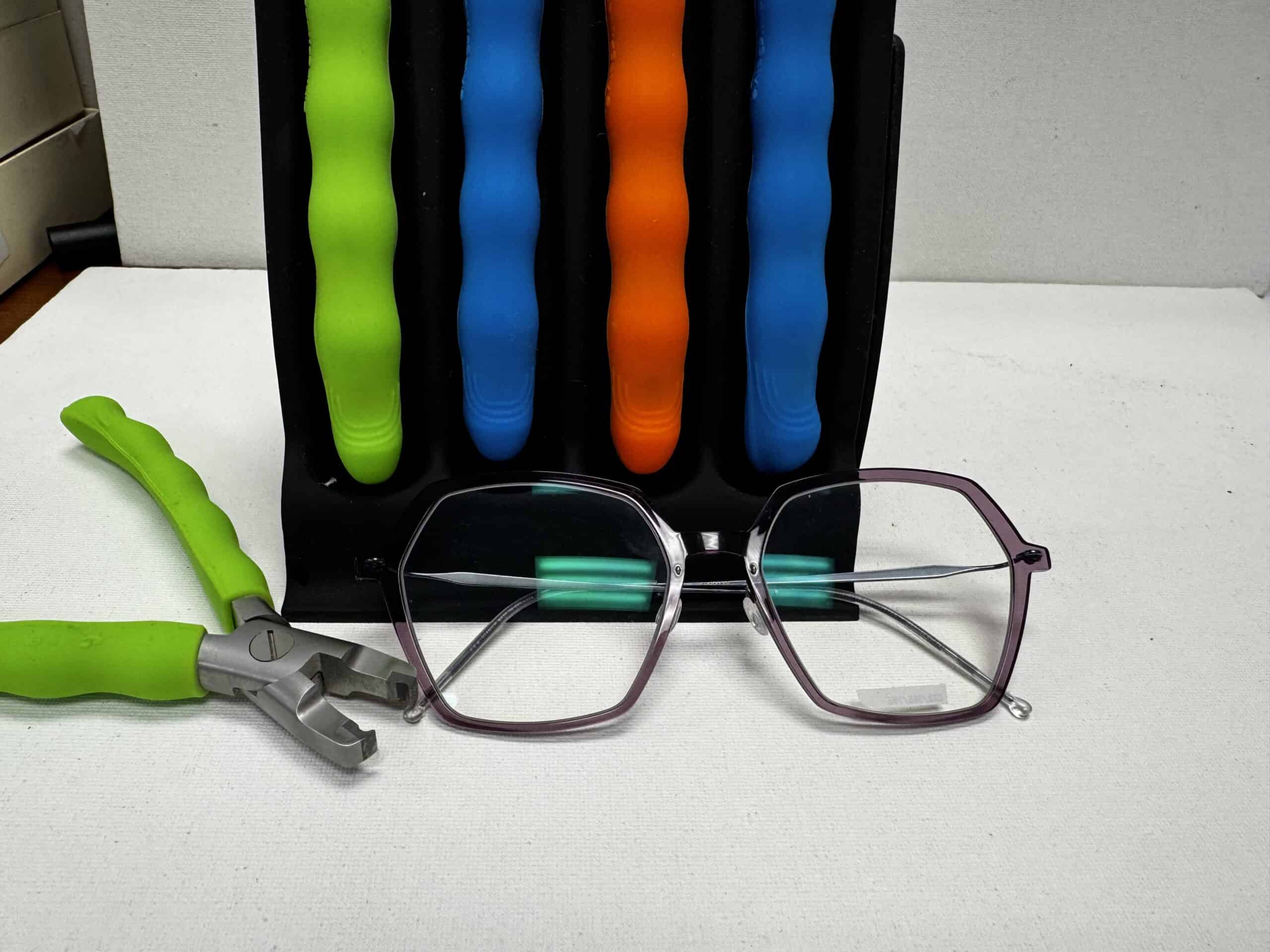
Opticians straighten frames with pliers made for each part, holding the frame on both sides of the bend so the force goes only where it should. If your glasses bend, wear a backup pair or tape them for the day and bring them in as they are.
Signs your frame needs a repair, not just a cleaning
Small frame problems tend to grow. These are the ones worth bringing in before something snaps.
Metal, plastic and rimless frames behave differently
What a frame is made of decides how it bends, how it breaks and what a repair can do for it. These are general patterns; an optician looks at your actual frame before saying what will work.
Glued frames are their own case: glue in a hinge or screw hole can block a proper repair. Bring the frame unglued if you can.
How an optician reads a broken frame
Some frames cannot be repaired, and the difference usually comes down to a few things we look at with you at the counter.
Where it broke
A loose screw or a bent arm is a repair at a spot designed to be serviced. A break across the bridge, through the front or at the base of a hinge sits where the frame carries load, and that is where repairs are most likely to fail.
Whether the part has to come from the maker
Some repairs need a part made for that exact frame, such as a sealed spring temple or a matching arm. Designer frames often use parts specific to their maker, and brands we have carried include Tom Ford, Oliver Peoples and Silhouette, all covered on our designer eyewear page. If your repair needs a part from the maker, we tell you first, before anything is ordered or taken apart.
Whether it is worth it to you
A frame you love, or one that fits a hard-to-fit face, is often worth saving. A tired frame with a second break may not be. We tell you what can be done and when a new frame makes more sense, and you make the call.
A repaired frame still has to fit
Fixing a hinge or straightening an arm is only half the job. A frame that was bent hard enough to need repair has usually moved out of shape somewhere else too, so the last step is an eyeglass frame adjustment: checking that both arms sit evenly, the front is level, and the lenses line up with your eyes.
That adjustment is the same care that goes into a new pair, covered on our eyeglass fitting page. If your glasses slide, pinch or tilt but nothing is broken, an adjustment alone may be all they need.
Questions about eyeglass frame repair
Usually, yes. A hinge screw that keeps backing out can often be tightened or replaced, and an optician checks whether the screw hole is still sound. If the hole is stripped or the hinge barrel has cracked, we tell you what a hinge repair involves for that frame before any work starts.
It depends on the frame. A bent bridge can often be straightened; a crack or snap at the bridge often will not hold. An optician will look at it with you.
Most repairs are done the same day. If your frame needs a part from the maker, such as a matching temple or a sealed spring hinge, we tell you first before anything is ordered.
Bring them to our shop at 436 Woodbury Road in Plainview and an optician will look at them with you. What can be done depends on the frame and the damage, not where it came from. Call 516-822-8971 if you have a question first.
Bring the frame in as it is
Unglued, unbent and with every piece you found. An optician will look at it with you and tell you what can be done.